Mikhail Gorbachev comments on the recent uprisings
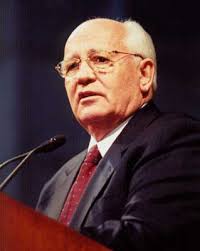
Mikhail Gorbachev is a Soviet statesman who served as General Secretary of the Communist Party of the Soviet Union from 1985 until 1991. He graduated from Moscow State University in 1955 with a degree in law. While he was at the university, he joined the Communist Party of the Soviet Union, and soon became very active within it. Gorbachev studied for a second degree at the Stavropol Agricultural Institute (1964-67) and in 1970 was appointed First Secretary for Stavropol Territory. His work in this post impressed Yuri Andropov, who was at that time the head of the Committee for State Security (KGB). Andropov used his considerable influence to promote Gorbachev's career.
On the death of Chernenko in 1985 Gorbachev was elected by the Central Committee as General Secretary of the Communist Party. As party leader he immediately began forcing more conservative members of the Central Committee to resign. He replaced them with younger men who shared his vision of reform.
Mikhail Gorbachev as head of the Soviet Union in the mid-1980s, started to restructure Soviet economic and political policy. Gorbachev wanted to bring the Soviet Union up to economic level comparable with capitalist countries such as Germany, Japan, and the United States. To achieve this Gorbachev decentralized economic controls and encouraged enterprises to become self-financing. The economic bureaucracy, fearing the loss of its power and privileges, obstructed much of his program.
He also made it clear he would no longer interfere in the domestic policies of other countries in Eastern Europe and in 1989 announced the withdrawal of Soviet forces from Afghanistan. By 1989 he had brought about the end of the Soviet occupation of Afghanistan and had sanctioned the end of the Communist monopoly on political power in Eastern Europe.
Later on 1992, and after receiving the Nobel Peace Prize, he became the head of Foundation for Social, Economic and Political Research, which was founded after August coup.
Mikhail Gorbachev is a Soviet statesman who served as General Secretary of the Communist Party of the Soviet Union from 1985 until 1991. He graduated from Moscow State University in 1955 with a degree in law. While he was at the university, he joined the Communist Party of the Soviet Union, and soon became very active within it. Gorbachev studied for a second degree at the Stavropol Agricultural Institute (1964-67) and in 1970 was appointed First Secretary for Stavropol Territory. His work in this post impressed Yuri Andropov, who was at that time the head of the Committee for State Security (KGB). Andropov used his considerable influence to promote Gorbachev's career.
On the death of Chernenko in 1985 Gorbachev was elected by the Central Committee as General Secretary of the Communist Party. As party leader he immediately began forcing more conservative members of the Central Committee to resign. He replaced them with younger men who shared his vision of reform.
Mikhail Gorbachev as head of the Soviet Union in the mid-1980s, started to restructure Soviet economic and political policy. Gorbachev wanted to bring the Soviet Union up to economic level comparable with capitalist countries such as Germany, Japan, and the United States. To achieve this Gorbachev decentralized economic controls and encouraged enterprises to become self-financing. The economic bureaucracy, fearing the loss of its power and privileges, obstructed much of his program.
Simultaneously, Gorbachev proposed reducing the direct involvement of the Communist Party leadership in the country’s governance and increasing the local governments’ authority. In 1988 a new parliament, the Soviet Congress of People’s Deputies, was created. Similar congresses were established in each Soviet republic as well. For the first time, elections to these bodies presented voters with a choice of candidates, including noncommunists, though the Communist Party continued to dominate the system. He also initiated glasnost which permitted criticism of government officials and allowed the media freer dissemination of news and information.
A newly created Congress of People's Deputies, (1989), voted in March 1990, to end the Communist party's control over the government and elected Gorbachev executive president. During 1990 and 1991, however, the reform drive stalled, and Gorbachev appeared to be mollifying remaining hardliners, who were disgruntled over the deterioration of the Soviet empire and increasing marginalization of the Communist party. An unsuccessful anti-Gorbachev coup by hardliners in August 1991 shifted greater authority to the Russian Republic's president, Boris Yeltsin, and greatly accelerated change. Gorbachev dissolved the Communist party, granted the Baltic states independence, and proposed a much looser, chiefly economic federation among the remaining republics. With the formation of the Commonwealth of Independent States on Dec. 8, 1991, the federal government of the Soviet Union became superfluous, and on Dec. 25, Gorbachev resigned as president.
A newly created Congress of People's Deputies, (1989), voted in March 1990, to end the Communist party's control over the government and elected Gorbachev executive president. During 1990 and 1991, however, the reform drive stalled, and Gorbachev appeared to be mollifying remaining hardliners, who were disgruntled over the deterioration of the Soviet empire and increasing marginalization of the Communist party. An unsuccessful anti-Gorbachev coup by hardliners in August 1991 shifted greater authority to the Russian Republic's president, Boris Yeltsin, and greatly accelerated change. Gorbachev dissolved the Communist party, granted the Baltic states independence, and proposed a much looser, chiefly economic federation among the remaining republics. With the formation of the Commonwealth of Independent States on Dec. 8, 1991, the federal government of the Soviet Union became superfluous, and on Dec. 25, Gorbachev resigned as president.
He also made it clear he would no longer interfere in the domestic policies of other countries in Eastern Europe and in 1989 announced the withdrawal of Soviet forces from Afghanistan. By 1989 he had brought about the end of the Soviet occupation of Afghanistan and had sanctioned the end of the Communist monopoly on political power in Eastern Europe.
Aware that Gorbachev would not send in Soviet tanks there were demonstrations against communist governments throughout Eastern Europe. Over the next few months the communists were ousted from power in Poland, Hungary, Bulgaria, Romania, and East Germany.
Gorbachev's attempts at reform as well as summit conferences with United States President Ronald Reagan and his reorientation of Soviet strategic aims contributed to the end of the Cold War, ended the political supremacy of the Communist Party of the Soviet Union, and led to the dissolution of the Soviet Union.
On August 1991, and following a coup of hardliners, Gorbachev resigned as General Secretary of CPSU, and dissolved Central Committee. On December 25 1991, he resigned as President when Soviet Union disintegrated.
For his contributions to reducing East-West tensions, he was awarded the 1990 Nobel Peace Prize. By 1990, however, Gorbachev's perestroika program had failed to deliver significant improvement in the economy, and the elimination of political and social control had released latent ethnic and national tensions in the Baltic states, in the constituent republics of Armenia, Georgia, Ukraine, and Moldova.
Later on 1992, and after receiving the Nobel Peace Prize, he became the head of Foundation for Social, Economic and Political Research, which was founded after August coup.
Commenting on the Arab spring Gorbachev is quoted to say:
“In these countries there used to be no real democracy. There were clans in power, who became completely ossified, fossilized, for 20 to 40 years. And this anger has piled up. So this means, either the military was in power, or kings were in power, and but actually kings could participate in democratization as well, if they wanted. Each individual country should decide for itself.
“What just happened in North Africa should be a lesson for all others. A society should never become like a pond with stagnant water, without movement. That’s the most important thing. And the second lesson, people won’t put up with democracy being introduced through bombs and tanks. Neither NATO nor the others will get away unpunished. One doesn’t forget something like that. There are many lessons to be learned from the Arab Spring.”
“What just happened in North Africa should be a lesson for all others. A society should never become like a pond with stagnant water, without movement. That’s the most important thing. And the second lesson, people won’t put up with democracy being introduced through bombs and tanks. Neither NATO nor the others will get away unpunished. One doesn’t forget something like that. There are many lessons to be learned from the Arab Spring.”

No comments:
Post a Comment